
Dog Training for First Time Dog Owners: What Really Matters
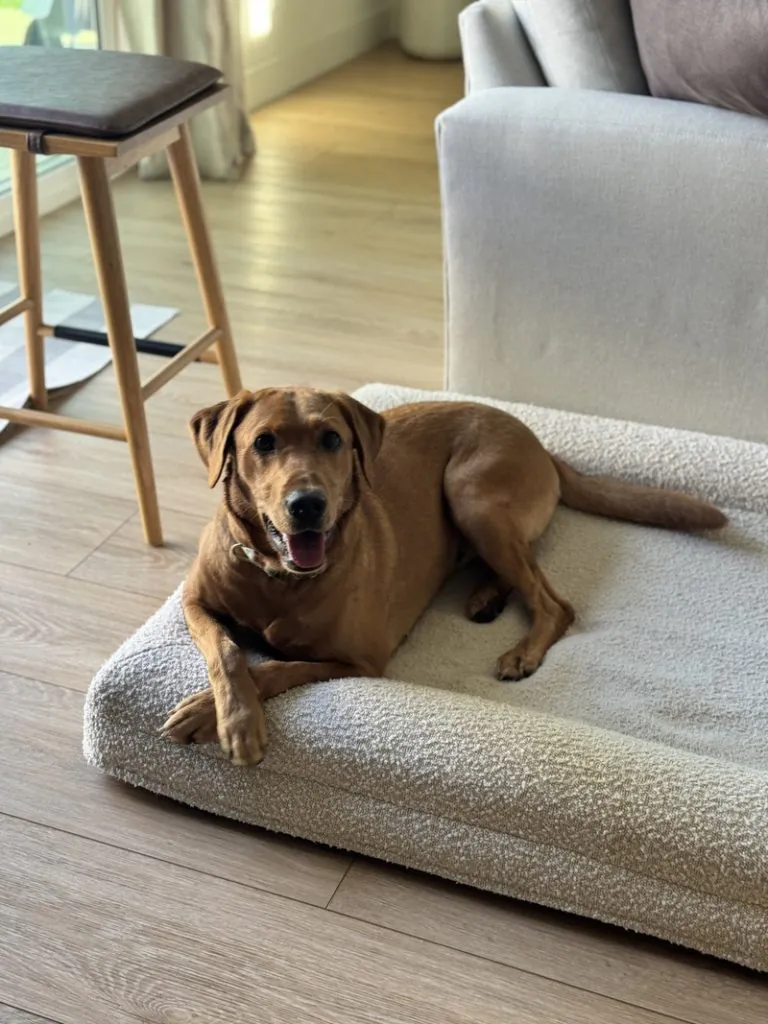
As a credentialed dog behavior consultant, most of my business revolves around resolving behavior issues with dogs in family homes. The most concerning of those include fear-based behaviors such as reactivity, aggression, over arousal, and impulse control issues. First time dog owners are much more likely to have difficulties in these areas, especially if they make poor choices with their dog early on. Here’s my advice on dog training for first time dog owners. You might be surprised at what you learn.
The First Rule of Dog Training for First Time Dog Owners: Positive Associations Before Obedience
Work on positive associations before obedience. How your dog feels in the moment matters more than what they do. A dog’s behavior corresponds to their emotions, so it’s more important to start with making sure they feel safe in many environments, especially around you. This means using positive reinforcement methods and avoiding the typical dominance based training you may have grown up with as a child.
There’s a recent study that shows aggression is more likely to show up in first time dog owners who choose to incorporate punishment into their dog training. This includes forceful techniques such as prong collar corrections, using electric collars for corrections, alpha rolls, and dominance-based training.
Howell, H., Baslington-Davies, A., Mills, D.S., and Hogue, T.E. (2025). “Risk factors for human-directed aggression by dogs: The human side of the problem. A two-part systematic review and narrative synthesis.” Applied Animal Behaviour Science, 284, 106552. This review gathered decades of research on the owner side of dog aggression. Eight of the studies it examined reported a significant association between physical punishment or confrontational training methods and human-directed aggression. The review also looks at first time ownership as a risk factor, including earlier work by Jagoe and Serpell that found a higher prevalence of human-directed aggression in the dogs of first time owners when handled, when in restricted spaces, and around food.
Careful Exposure to Novel Stimuli
This is extremely important, but you should not overdo it. Veterinarians are very helpful, but something they seem to lack is an understanding of the critical socialization window that is important to take advantage of. This falls approximately between 8 and 14 weeks of your puppy’s life. Keeping your puppy inside your home or your backyard can be very detrimental to the confidence and social skills of your dog. There are many safe ways to take your dog out of the house and expose them to what you’re going to expect them to deal with for the rest of their life. See this puppy socialization guide on how to understand this better.
Confinement and Boundary Training: Management From the Beginning
Confinement and boundary training means incorporating proper management from the beginning. I can’t tell you how many problem behaviors we could solve if we just started out with careful, prudent management that does not let dogs practice unwanted behaviors. This includes crate training, adding gates and exercise pens, and proper use of tethers and leashes.
Without proper management early on, dogs learn to practice behaviors we don’t enjoy but that they do. This includes jumping on guests, not listening when you’re calling them, getting underfoot, stealing food, guarding spaces, and barking at dogs or other humans. If your dog starts practicing these behaviors early on, it’s going to be harder to stop them later, as these behaviors become more practiced and your dog expects to be able to do them. That makes changing later more frustrating for them.
The Behaviors That Actually Matter in Beginner Dog Training
Teach behaviors that will actually matter and be useful across the board. I keep my list short. Here’s what I teach.
Go to Place or Settle
“Go to place” and down on a target like a mat, which includes learning how to wait, which is patience, impulse control, and learning how to feel safe. Place or station training covers both ends of the exercise. The wait cue tells your dog to stay and settle, and the release cue tells your dog when they’re done. This is basically a stay, but one that your dog thoroughly enjoys. The behavior of going to an assigned place anywhere with you, with a relaxed down stay and attention, is invaluable.
Once you train a positively associated go to place, that place, which is usually a mat, can travel with you to environments that are unknown or even a little bit scary. The positive association you built with that mat and the behaviors your dog practiced on it will help them succeed in that new environment, which could be a restaurant patio, a park, a friend’s house, or even a boat or a car.
Hand Targeting

Hand targeting, and targeting in general, is essentially your recall, but it is much more. This is a luring exercise that teaches your dog to put their nose on your hand when you present it through reward-based training. You can teach your dog to get on or off of something, you can teach them tricks with this, and you can teach them to focus on this simple exercise when they’re overwhelmed in the future.
Because dogs love this exercise so much, it also works as a diagnostic. It tells you whether fear or excitement has overwhelmed your dog If they cannot complete a simple 6 inch nose touch to your hand, you’re asking too much of them in the moment. This is both a wonderful behavior that I use every day with my dogs and a way to check on their state of mind. You can also teach the majority of an agility course with this simple technique.
Focus and Eye Contact
This is one of the most important aspects of understanding if your dog is listening to you. If your dog can’t offer you a glance or a simple gaze into your eyes, many times they’re not fully present with you. This is a great behavior to ask them to do before you ask for another behavior, and it’s also a solution for distraction, because if they’re engaged with you they’re more likely not going to be engaged with something else. This is a great contingent behavior your dog can perform, just like hand targeting, before you allow them to do something else like run off leash or get their food or anything else.
Unmet Needs Show Up in Your Dog’s Behavior
Last but not least, when a dog’s needs aren’t met for their breed, life stage, skill level, or emotional standing, it is likely your dog will tell you so through their behavior.
Most new dog owners need to lower expectations and forget everything they’ve seen on TV, especially from certain TV celebrities. Consider the actual breed you got and the environment it lives in. The majority of the behavior work that I do starts with addressing what’s missing in the environment, what the dog’s routine is if they even have one, what the dog does to stimulate itself in the ways that it needs, and if the dog feels safe.
For anybody looking to understand how to fulfill their dog’s needs better, reduce stress, and support a better relationship, I recommend Kim Brophey’s L.E.G.S. course and her new Total Welfare app. L.E.G.S. stands for Learning, Environment, Genetics, and Self, and it gives you a framework for looking at your dog as a whole animal instead of a list of problem behaviors. The Total Welfare app takes that framework and helps you track what your individual dog actually needs and how well those needs are getting met over time.
Every Home Needs a Safe Place
Every home should have a safe place for their dog where they can relax without being bothered. This means by anybody in the family, including children. Homes with children are some of the most challenging environments to train in.
Dogs require more sleep than you probably imagined, and they need a quiet place to do that. Puppies and older dogs require more sleep, and we need to respect that need.
Learn How to Play Properly With Your Dog
This doesn’t mean just tossing a ball down the hallway. Early training that incorporates play with rules and boundaries is very helpful for the developing brain, and it builds confidence and trust through challenge. It is also very helpful for dogs who are overwhelmed by their immediate environment. I love a good game of fetch with tug after. Teach drop and wait after fetch to pick up the toy for another round of fun.
I suggest letting your dog win most of the time and not bringing up their energy or arousal too high. An easy way to train drop is to just say the word drop and put a piece of delicious food on your dogs nose when they have anything in their mouth. They don’t actually have to drop something to get the food, just say the word and then put the food on their nose. If you do this enough times, they’ll learn to open their mouth when you say the word drop.

Leash Walking Advice for New Dog Owners
Dogs think through their noses, so consider how you walk your dog. I find it’s much easier to walk any dog with a little bit longer leash to prevent them from just running into the end of it. I recommend a 10 ft leash for that reason, regardless if they pull.
On that walk I try to mix in appropriate ratios of sniffing and rewarding attention and engagement. Before you try to go anywhere substantial, just work on being outside with your dog paying attention to you.
The most important tip I have for learning how to walk on leash is not to walk anywhere. Put a long leash on your dog, let them sniff the environment, and when they want to go somewhere else they will tell you. Do not follow them if they are pulling on the leash. Reward them heavily every time they even look in your direction, treat after treat after a treat for looking at you. Then eventually stop treating them and take them down the street another 10 to 15 ft to sniff.
If you nail this exercise and you build on it daily, your dog will never learn that pulling gets them anywhere, because you never started that. This is the biggest mistake I see in training a dog to walk on leash. People start to walk without any rules or consideration that it is a team sport.
Meeting People and Dogs: What Most First Time Dog Owners Get Wrong
When it comes to meeting people or dogs, think the same way. Just because you see a dog or a person does not mean they’re entitled to engage or reward your dog. Everybody you see is a potential trainer, and they’re likely going to be rewarding excitement.
It’s not necessary to have the entire neighborhood socialize with your puppy or dog. Many dogs aren’t interested in as much as you think. I know many people think this is good socialization, but it is just teaching bad behaviors and setting the expectation that everybody they see or every dog they see is an opportunity to disengage from you, pull, and get rewarded. Don’t start this.
This is especially important for dogs like golden retrievers, Cavalier King Charles spaniels, Labradors, or any dog who finds people and other dogs particularly exciting. Teach them how to get there. The most important thing is to learn how to watch people and dogs pass you by and feel good about it. So I advise, when you’re learning how to walk, teach your dog that every person they see gets rewarded with delicious food.
Don’t spend all of your time out there on that walk. Get quantity over quality, rinse and repeat frequently. The goal of walking is not to get anywhere but to teach what to do and how to feel when you see something interesting.
If you start with these two pieces of advice, your experience outside on leash with your dog will be vastly better than if you just follow them around trying to keep them by your side and letting them meet everybody who’s friendly and gushing over your dog.
Dog Training for First Time Dog Owners: The Short Version
Here’s everything above in one place.
Start with how your dog feels, not with what your dog does. Emotions drive behavior, so build safety and positive associations first and leave the punishment tools alone. Take advantage of the socialization window between 8 and 14 weeks, but expose your puppy carefully instead of flooding them.
Manage the environment from day one with crates, gates, pens, tethers, and leashes, because every unwanted behavior your dog gets to practice becomes a behavior you have to undo later. Keep your training list short. Go to place on a mat gives you patience, impulse control, a wait cue, a release cue, and a portable safe spot you can bring anywhere. Hand targeting gives you a recall, a redirect, and a reliable read on whether your dog is over threshold. Focus and eye contact tell you whether your dog is present with you before you ask for anything else.
Look at what your dog needs for their breed, life stage, and skill level before you look at their obedience. Give them a safe place to sleep where nobody bothers them. Play with rules and boundaries. Walk them on a 10 ft leash with plenty of sniffing, reward every glance in your direction, and teach them that people and dogs pass by without an introduction.
Do those things and you will avoid most of the problems that bring first time dog owners into my office.

With over a decade of experience in dog training and behavior modification, I’m dedicated to helping families create stronger bonds with their pets. I specialize in resolving challenging behavioral issues and guiding new puppy owners with confidence. At OC Canine Coaching, I blend science-based techniques with compassionate training to deliver lasting results. My work focuses on helping dog owners in Orange County raise calm, well-mannered companions through tailored coaching and ongoing support.