
My Dog Bit Me After Using a Shock Collar: What Now?
- | Blog
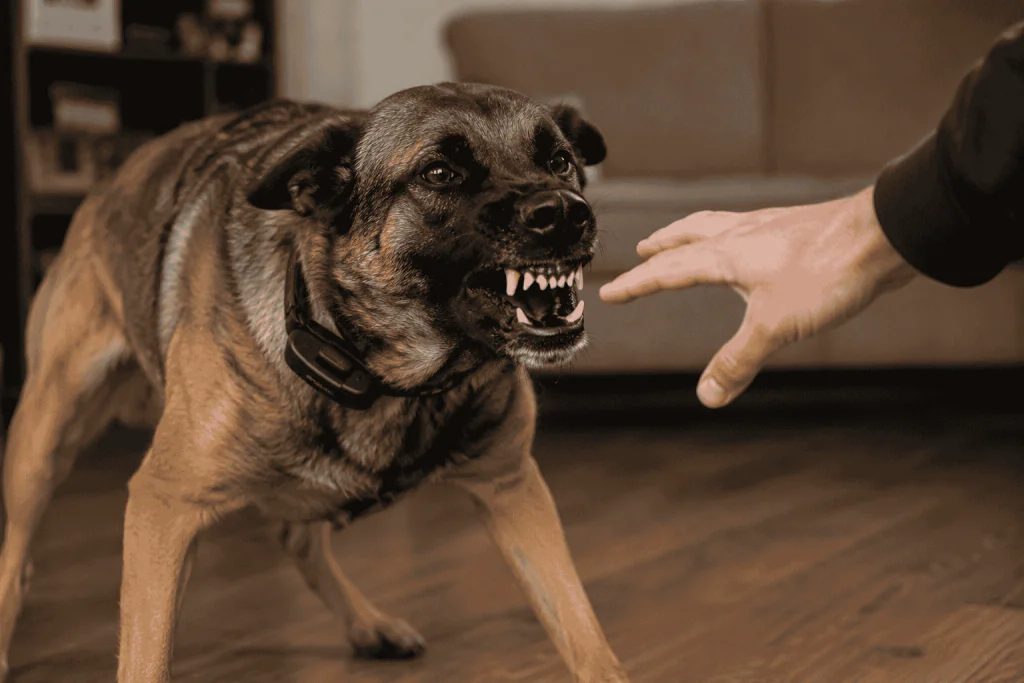
If this happens to you, stop using the shock collar, separate your dog from whatever triggered the bite, and call a credentialed behavior consultant before you do anything else.
Your dog is not ruined. What has likely happened is that your dog associated you with the discomfort of the collar. I am a certified dog behavior consultant (CDBC) in Costa Mesa, California, and I work with owners whose dogs have bitten them. This article covers why the bite happened, whether it is likely to happen again, and what to do in the coming days and weeks.
Why did my dog bite me after shock collar training?
Because your dog learned that you predict the shock, and biting is what makes it stop. Dogs are good at spotting patterns. If pain keeps showing up when you are there, your dog starts watching you, not the behavior the collar was supposed to fix. Researchers found exactly this when they studied dogs on shock collars. Those dogs showed stress during training, and they still showed it on ordinary walks in the park afterward. The researchers concluded the dogs had connected their handlers with getting shocked (Schilder and van der Borg, 2004). Some of them redirected and bit the handler.
Worth knowing: that study looked at police dogs rather than pets. Dogs learn the same way either way, which is why the finding matters here.
Veterinary behavior specialists say the same thing. In a December 2025 letter to the head of the American Veterinary Medical Association, the American College of Veterinary Behaviorists wrote that dogs rarely learn what the shock was for. The timing has to be near perfect, and almost nobody can hit it, including some professionals. What dogs learn instead is fear, and they learn to avoid the person holding the remote.
Is a shock collar the same thing as an e-collar?
Yes, an e-collar and a shock collar are the exact same thing with a different name. Advocates for the tool chose the term e-collar to strip the stigma from the word shock. Simply put, it’s marketing. Either way, the collar sends an electrical current through electrodes against the dog’s neck, and the dog feels discomfort. Lowering the level does not change what the dog learns from it.
Did the shock collar cause the bite?
Not necessarily, but it may have been a contributing factor. Several things contribute to human-directed aggression and dog bites to owners. As a certified dog behavior consultant, I look at all the factors that lead to aggression so we can make the best training decisions for both the dog and their humans. That analysis covers the dog, the human owner, and the environment the dog lives in.
When researchers asked behavior professionals what raises the risk of a dog biting someone, the answers covered the dog, the owner, and both the social and physical environment the dog lives in.
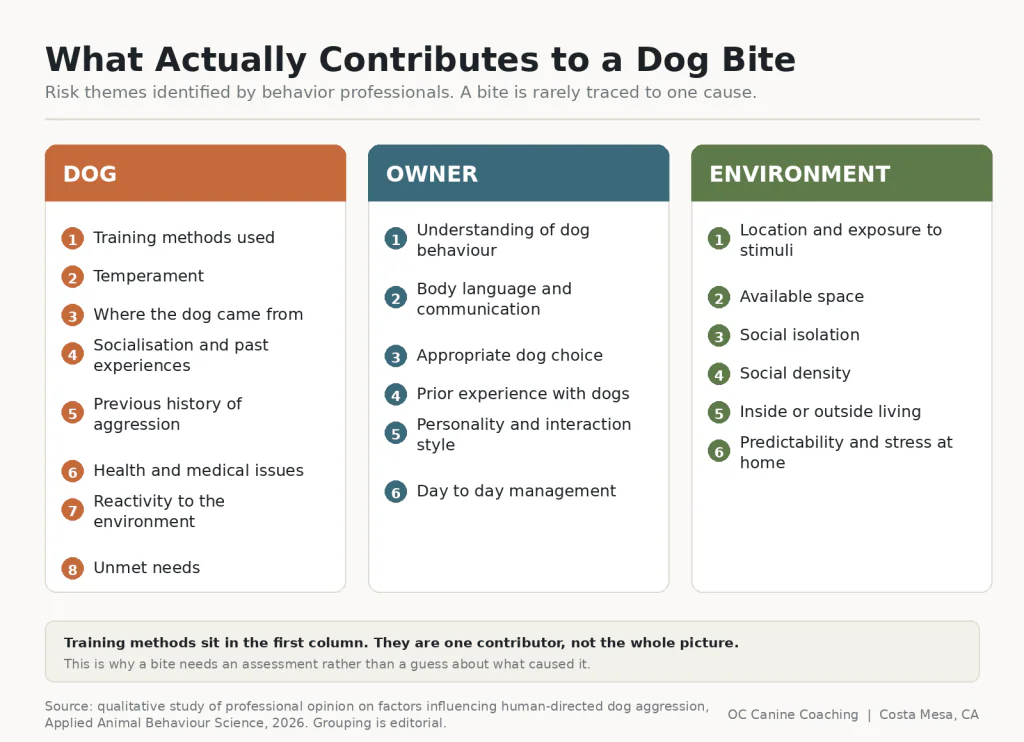
I have to look at all of these to understand where the dog is coming from and why your dog chose to bite you. For most dog owners, this definition of aggression is worth remembering.
“Aggression is a behavior used to increase distance from or eliminate a provocative stimulus or threat.” Michael Shikashio, CDBC
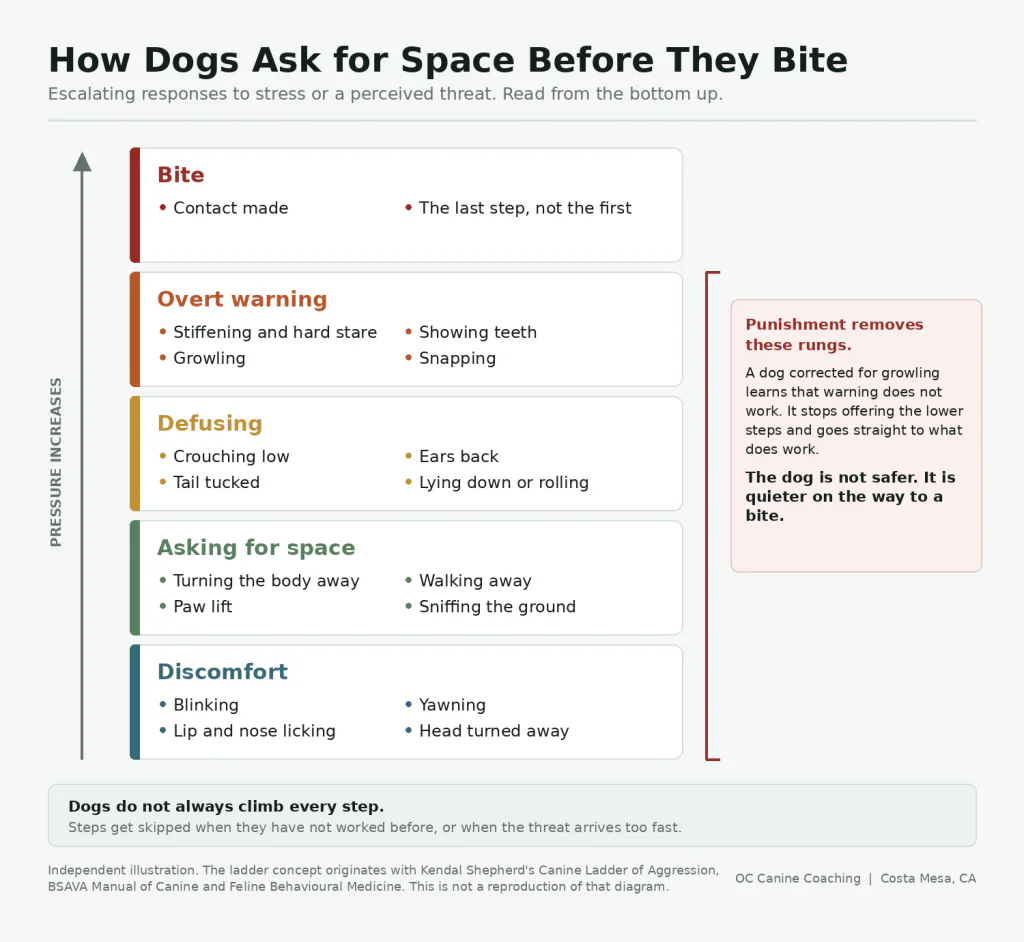
Most dogs who bite have already tried to tell someone they wanted distance, or that they needed something in the environment to go away or stop. The problem is that we miss those earlier attempts, which leaves the dog with biting as the last option.
If you ignore your dog’s attempts to tell you they are uncomfortable, or if you reprimand them for growling, you risk teaching your dog that violence is the only option left.
My dog bit me. What should I do now?
However serious the bite was, you need to make some adjustments quickly.
1. Take a deep breath and create distance. Put the dog behind a gate, outside, or anywhere else they can decompress while you think through what happened. Do not use force to do it. Do not reprimand the dog. I can’t tell you how many times an overreaction has made the whole thing worse and confirmed the dog’s decision to choose aggression over other options.
2. Clean your wound. Wash it with warm soapy water for a full minute to flush out bacteria and debris. Skip the alcohol and hydrogen peroxide. Both damage tissue and slow the healing.
3. Take a careful accounting of the events leading up to the bite. Think about what happened earlier that week, that day, and in the moments right before. Was there high value food or a resource nearby? Other dogs? How were you handling your dog? Neck corrections from tools like a prong or shock collar leave many dogs sensitive in that area. Taking the collar off, or even removing a bandanna after grooming, can trigger a bite.
4. Call for professional help. That means a behavior professional and a veterinary professional. A behavior professional like myself, with certifications and an understanding of animal behavior, can help you find clarity about what might be driving the aggression. That professional will likely ask you to see a veterinarian as well to rule out medical issues. Aggression often increases alongside other contributing factors like arthritis, digestive issues, skin allergies, or anything else that causes pain and discomfort.
Dog Trainer Red Flags and Honest Communication
Bear in mind that most dog trainers you find when you search for help carry almost no credentials you can verify. I can assure you your dog was not trying to become the alpha or dominate you, so avoid anybody who tells you to dominate your dog. This is not the time to send your dog to a boot camp. This is the time to learn more about your dog and why he felt the need to bite you.
Be honest with whoever you call. I don’t judge my clients, even when they did something they deeply regret. They are calling me for help and I need the whole story. Even if they hit their dog, I need to know that. We can all improve how we behave and how we understand each other once we have the facts.
2 case studies of dog bites to their owners
Case one: Duke, two-year-old shepherd mix
Acquired: five months old, from a negligent breeder
Owners: first-time dog owners
Original purpose: property protection at the family business
Early history: limited socialization during the critical window
Prior training: eight-week board and train using prong collars, later a program built entirely around e-collar work, plus remote coaching that included positive reinforcement
Presenting incident: severe bites to the owner’s wife during a routine crate release
Duke’s History
HistoryHis owners bought Duke at five months as a protection dog. At around twelve months he began growling at customers, and they responded with escalating containment: a kennel, then his owner’s office, then an eight-week board and train that ran on prong collars. He came back with excellent obedience and unchanged protectiveness. Over the following year they neutered him for dog-directed aggression, stopped taking him to dog parks, stopped taking him to restaurants after he lunged at a waitress, and moved him into a program that ran entirely on e-collar work. Video from those sessions shows Duke turning aggressive toward the trainer when the trainer used the e-collar, particularly at moments when Duke tried to disengage and move toward his owners. Nobody in this family was neglecting their dog. They spent a year and a half and considerable money trying to help him.

The bite came hours after one of those sessions, during a routine they had run hundreds of times. Duke waited on his place command for release to his crate and a food-stuffed toy. His owner’s wife noticed the e-collar was still on and reached toward his neck to remove it. Nobody corrected him, raised their voice, or forced him anywhere. A hand moved toward his neck, and Duke bit what sat closest to his face, her neck, and then her arms.
Training Assessment
My assessment is that for roughly a year everything unpleasant in Duke’s life arrived at that spot, first as prong pressure and then as stimulation, and a hand reaching there had become a reliable predictor of it. The video matters here: he already showed aggression around the collar, and specifically when he tried to move toward the people he trusted. In my clinical opinion the collar work was a major contributing factor, stacked on other stressors including his daily routine and immediate environment. This dog had excellent obedience but a sensitive and conflicted emotional state, and his training had stripped away his warnings. Add the novice owners and it is a recipe for issues like these.
What happened next. I completed an in-person evaluation and referred the family to veterinary care. Duke is now on behavioral medication and the e-collar is gone completely. The positive reinforcement work they had been doing remotely gave them a foundation to stand on once the collar came off. His owners report he is doing better, the relationship is stronger, and they are no longer afraid of him. They have started using tug and other forms of play to stimulate him, and they mix in obedience that Duke enjoys. They have expanded his space, moved to a longer leash, kept the muzzle on, and taken him camping, something they had never attempted with this dog. Nobody is calling this resolved. The case is ongoing, I reassess after eight weeks on medication, and management stays until then. What changed first was not obedience. It was taking the pressure off and treating the emotional state underneath it. Simple changes, big results.
Case two: Kirby, three-year-old Doberman
Acquired: twelve weeks old, in his current home one year
Owners: first-time dog owners
Temperament: low confidence, sound-sensitive, resource guarding around high-value food
Prior training: two-week board and train at three months old, then two separate trainers using e-collars and prong collars
Medical: neutered at two with post-surgical complications including an abscess, now difficult to handle at the vet
Presenting history: three escalating bites, almost exclusively to the male owner
Kirby went to a two-week board and train at three months old. He has been through two trainers since, both using e-collars and prong collars. There is visible scarring on his neck from the prong collar, a patch of white hairs on a black dog. He is touch-sensitive around that same area.
The bites escalated. At one year, a nip near food to the male owner’s arm, bruising without puncture. Later, a bite to the forearm with a small puncture, right after an e-collar correction for barking. The most recent came after a stressful veterinary visit to check the abscess site: three punctures to the arm. Kirby gave a full sequence of warnings first, including head turns, lip licking, air snaps, and growling.
Almost every bite has gone to the same person. The male owner is inexperienced, has feared dogs his whole life, and puts the least time into the relationship. Kirby also shows protective tendencies around the female owner, including toward her husband. He spends most of his time outside in the yard, where he practices barking at neighbors, and he gets little enrichment.
My Assessment
Kirby’s neck is sensitive and may still hurt after a year of neck corrections with a prong and e-collar. Repeated stressful vet visits likely added to that sensitivity around handling, especially around the neck. The warnings he gave beforehand were not the problem. Misunderstanding and disrespecting them was, though. This likely comes down to the owners’ lack of experience caring for dogs. A 2023 review of the research on dog bites found that owner experience and training methods both matter, and that physical or verbal punishment had the largest effect of any factor they examined. I cannot say the collars caused these bites. What I can say is that several factors, including Kirby’s social and physical environment (which the shock collar was part of), led him to bite, because everything else he had tried had stopped working.
What we did. We stopped using all corrective tools and built a positive association with the male owner specifically, teaching Kirby to go to a place and settle for food. We followed by playing food-search games where he returned to target the husband’s hand. The owners added gates and tethers so Kirby could stay inside with the family under management rather than alone in the yard.
We switched to a front-clip harness and a ten-foot leash, and we used reinforcement to change how he responds to dogs on leash, which had made walks difficult. Neck handling came last, using the dopamine box protocol shown above; Kirby earned rewards in a marked spot while his owners worked up to more contact, eventually including the harness, which the husband had dreaded.
Where he is now. No further aggressive incidents with the family. They have safely had guests in the house. All corrective tools and equipment are gone.
So what should you take from all this?
Neither of these dogs was aggressive by nature. Both dogs gave warnings until punishment taught them to stop, and both bit the person most likely to correct them. Neither recovery started with obedience. We removed the pressure and negative relationship with training first. Careful exposure work, paired with positive associations, gradually taught both dogs they had options other than biting.
If your dog has bitten you, that does not make your dog dangerous by nature. A dog bite doesn’t make you a bad owner. Most owners in this position followed instructions from someone who sounded qualified.
You also do not need to be thinking about euthanasia right now. Most dogs who bite do not end up there. That decision does not belong in the first days after an incident. You are frightened, and you do not yet know what you are dealing with. Get the assessment first. You can still have that hard conversation later, with better information behind it.th better information behind it.
Getting help
I am a Certified Dog Behavior Consultant through the IAABC, based in Costa Mesa, California. I work bite cases across Orange County in person and elsewhere virtually, often in collaboration with veterinarians. Every case starts with a full history and an assessment rather than a training package. Aggression has no one-size-fits-all solution, and it takes careful work to avoid future problems. Dogs do not forget how to use aggression. What we can do is teach them to choose something else when they feel uncomfortable. As we learn to communicate better and listen to our dogs, we reduce conflict and improve our relationships going forward.

With over a decade of experience in dog training and behavior modification, I’m dedicated to helping families create stronger bonds with their pets. I specialize in resolving challenging behavioral issues and guiding new puppy owners with confidence. At OC Canine Coaching, I blend science-based techniques with compassionate training to deliver lasting results. My work focuses on helping dog owners in Orange County raise calm, well-mannered companions through tailored coaching and ongoing support.