
Hidden Causes of Dog Behavior Problems
- | Blog
It's Not Dog Psychology. It's Just Psychology.
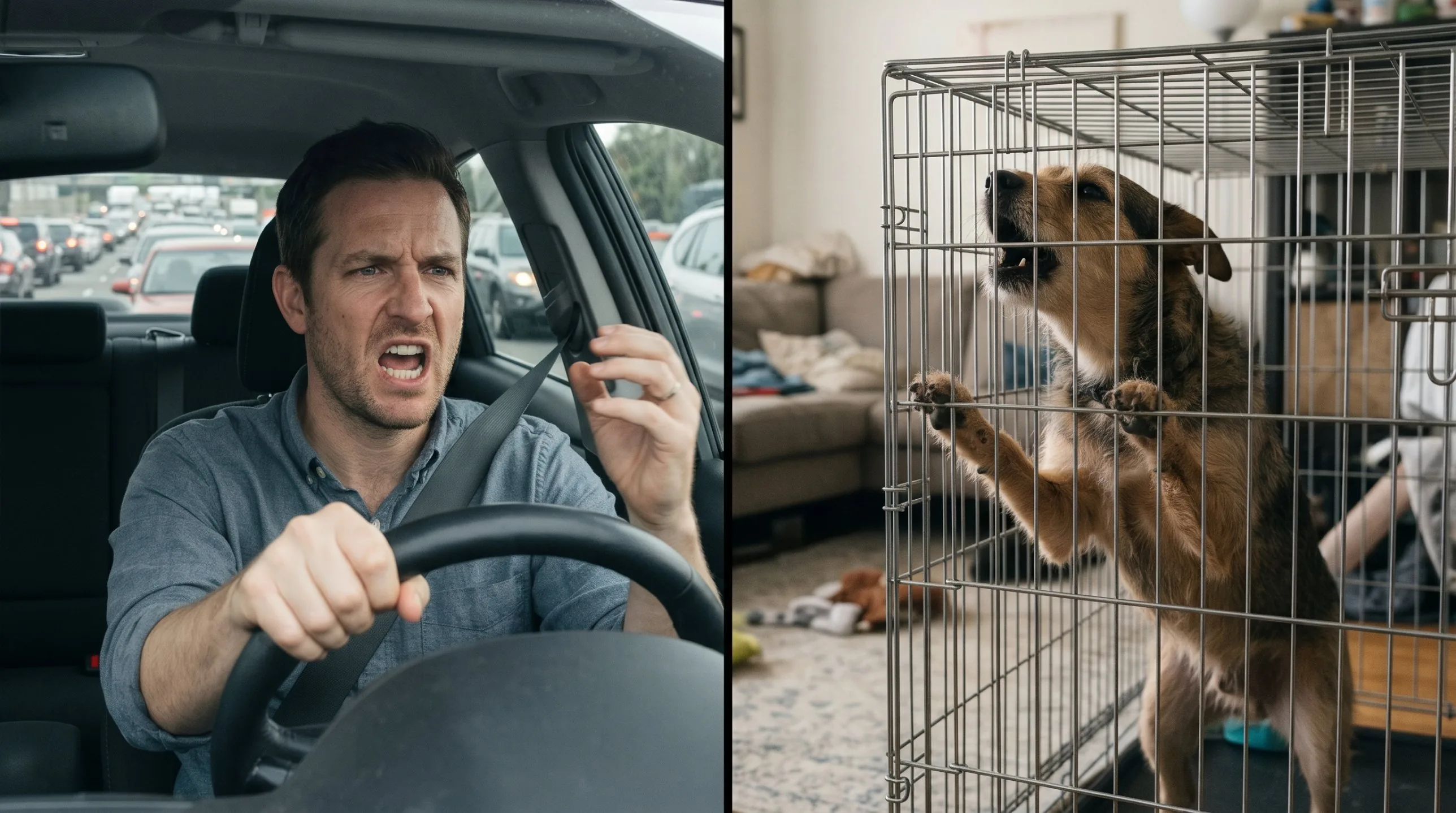
Your dog's barking, lunging, or snapping runs on the same biology that makes you snap at someone you love after a bad night. That shared biology is where most hidden causes of dog behavior problems begin. Fear learning, reward learning, stress hormones, and the urge to escape discomfort are shared across mammals. It's not dog psychology. It's just psychology.
That matters because blame is a dead end. "He's being stubborn" or "she's dominant" ends the conversation. "What is driving this, and what can we change?" starts one.
Rushing to common conclusions like my dog is being alpha, dominant, protective or even anxious misses the mark. These are just labels that mean different things to different people. Let's stick to what we all understand, because the science behind it is the same.
This guide pairs common dog problem behaviors with the human version you have probably lived through, then points to the hidden drivers that tend to sit underneath both.
The Sapolsky lens: every behavior has a back story
Stanford neuroscientist Robert Sapolsky explains any single act by stepping backward in time. In Behave (2017) the chapters literally walk from one second before a behavior, to seconds and minutes before, hours to days before, days to months before, then adolescence, childhood, the womb, and genes. In Determined (2023) he goes further and argues that there is far less free will than we assume, because every behavior is caused by what came before it.
When you understand this framework for behavior, you'll take your dog's behavior much less personally, and by default offer more reasonable consequences because you understand your dog is having a hard time, not giving you a hard time.
You do not have to accept his full position to use the tool. The practical point is simple: by the time your dog lunges, most of the causes are already in place, and almost none of them were chosen in that moment, meaning much of our behavior is subconscious.
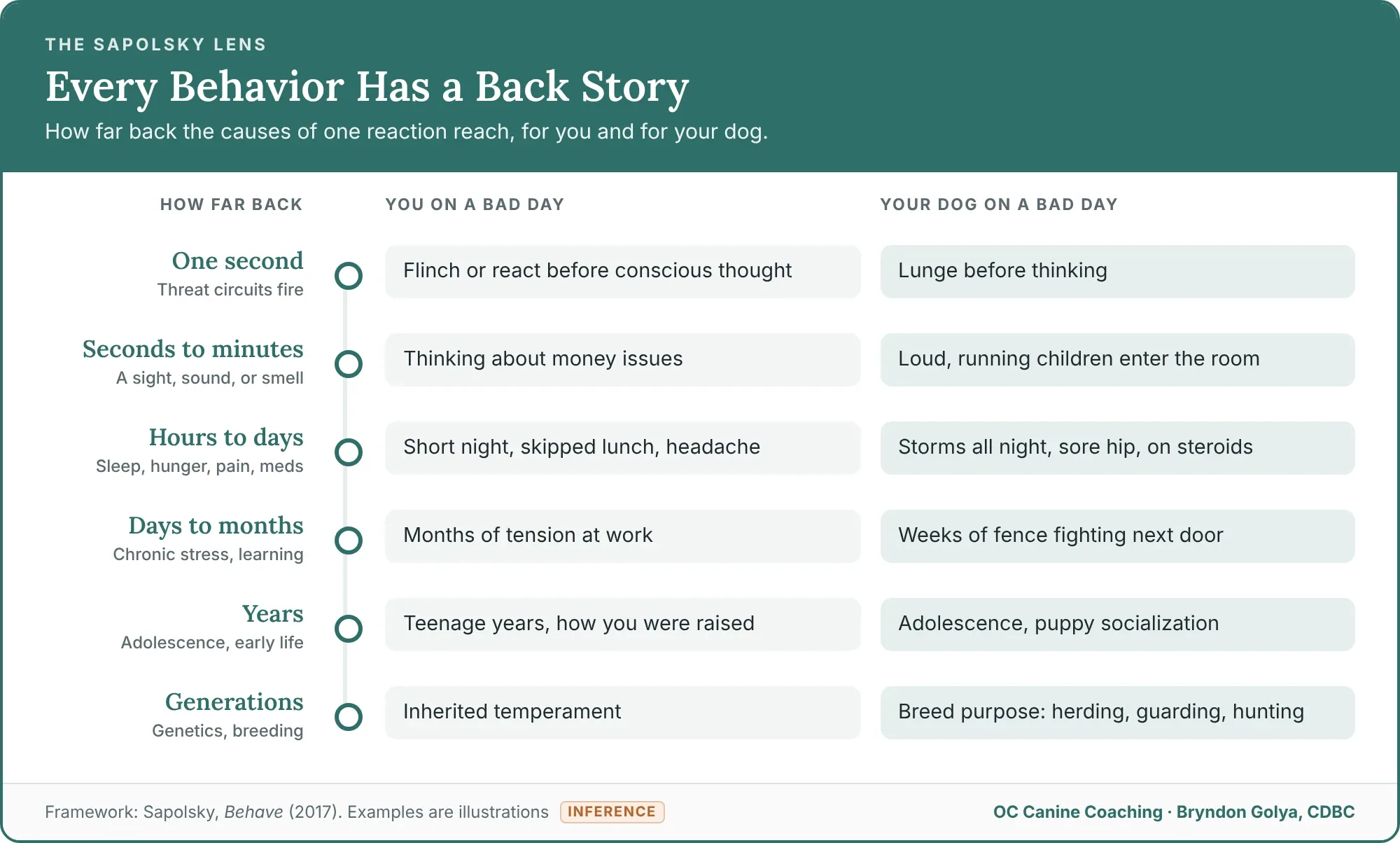
Inference: The two right-hand columns are illustrations built on Sapolsky's framework, not his examples. The framework itself is his.
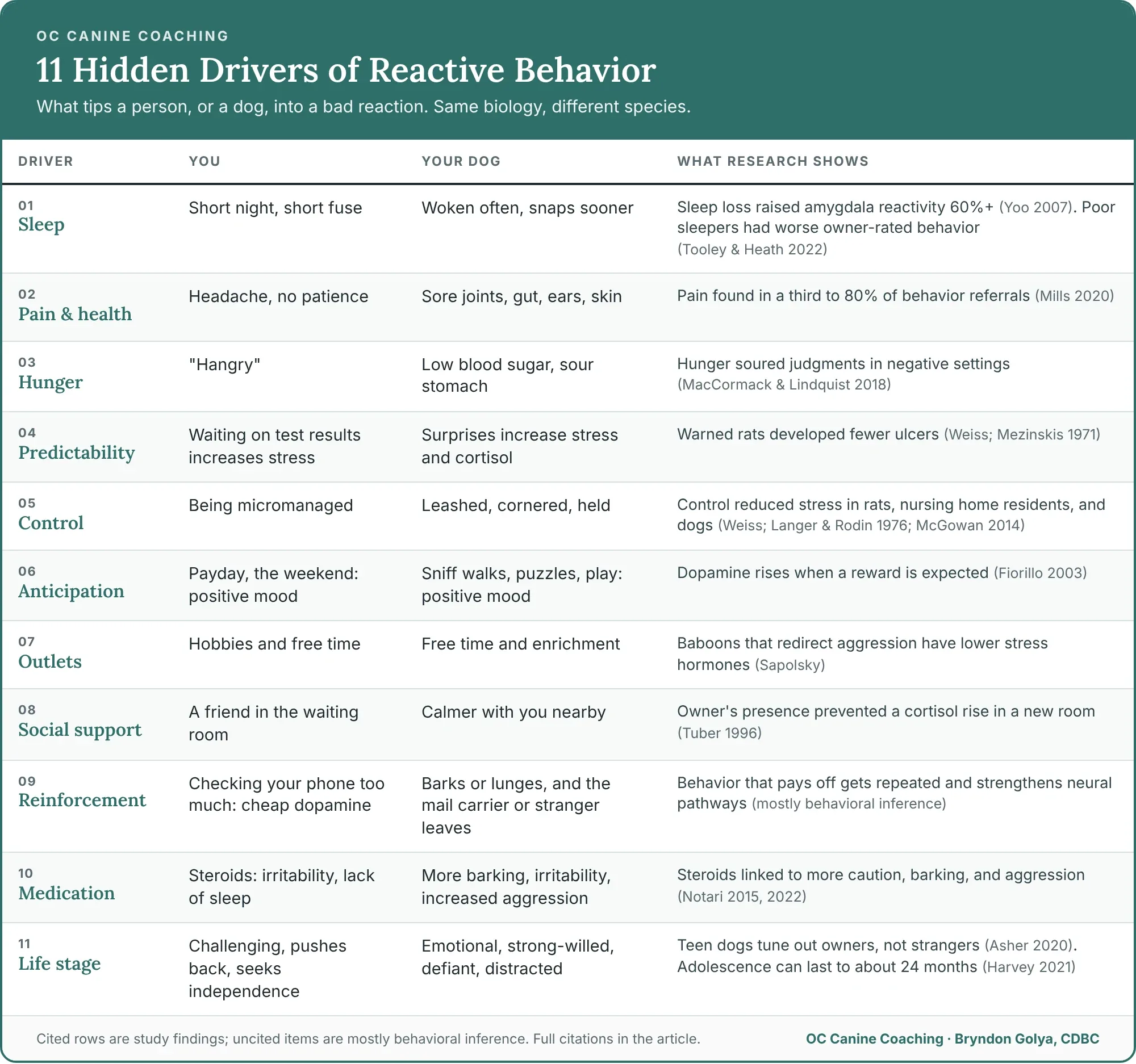
The Hidden Causes of Dog Behavior Problems
Most of what tips a person or a dog into reactive behavior lives in the body and the environment, not in a moment of bad character. In Why Zebras Don't Get Ulcers, Sapolsky lists the big stress buffers: an outlet for frustration, some control over the stressor, the ability to predict it, and social support. The drivers below build on that list.
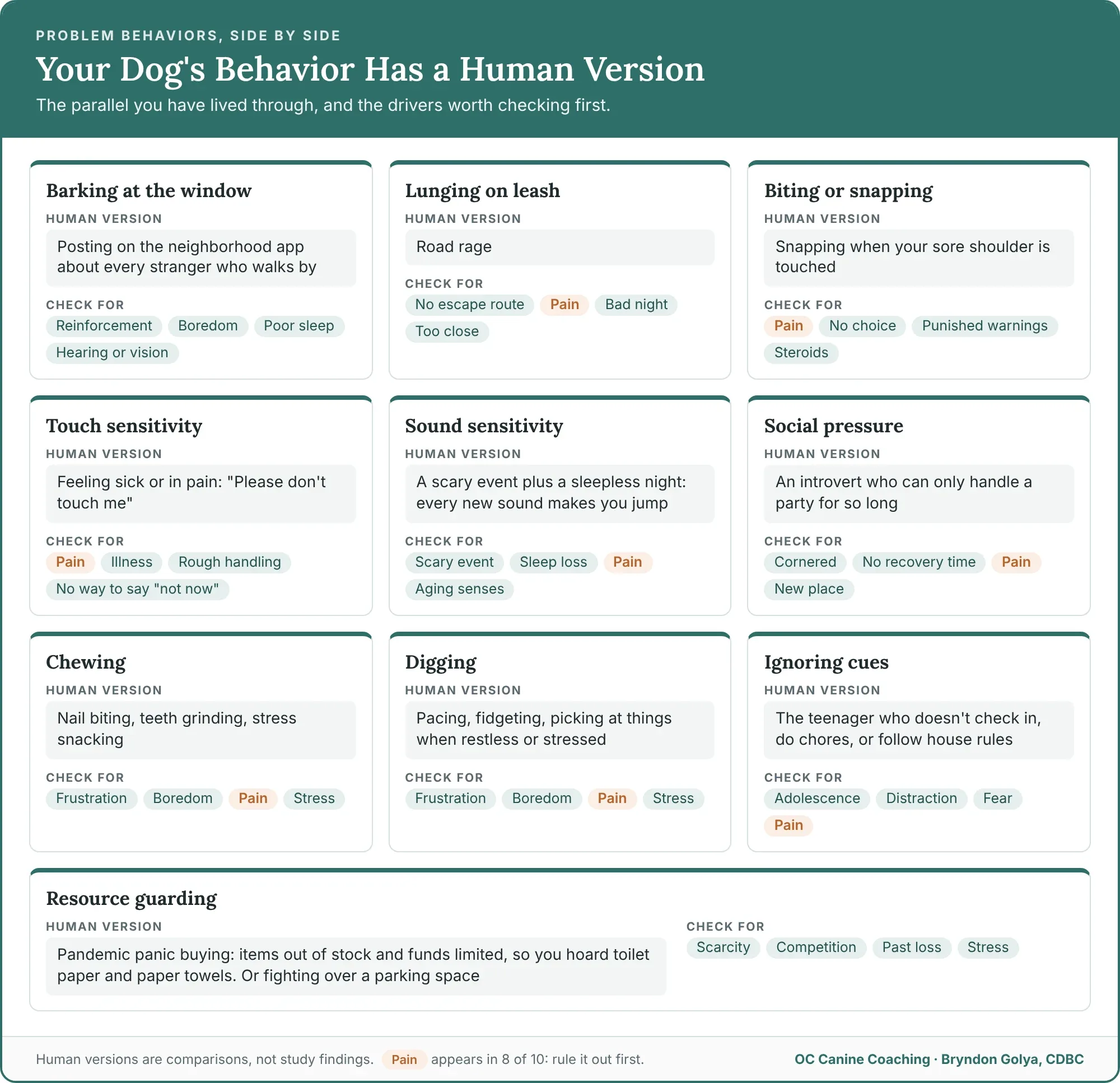
Problem behaviors, side by side
Each dog behavior below has a human version most of us recognize. The human parallels are Inference: analogies built on shared mechanisms, meant to help you see the dog's experience, not to claim the experiences are identical.
Two cases where the research is especially clear
Pain and biting. In 12 dogs with pain-related aggression, most had hip dysplasia. Dogs that had not been aggressive before their pain began were more impulsive, gave less warning, and were more likely to bite when handled (Camps et al., 2012). The human parallel: the gentlest person you know may still yelp and swat when you grab an injured arm.
Pain and noise fear. Comparing noise-sensitive dogs with and without musculoskeletal pain, the dogs in pain developed the problem about four years later in life and avoided wider areas after a scare (Lopes Fagundes et al., 2018). The researchers suggest a startle may tense already sore muscles, so the noise becomes linked with pain. If an older dog suddenly fears sounds, a vet exam comes first.
Trigger Stacking: Same Trigger, Different Day
The same trigger can get a shrug on Tuesday and an explosion on Saturday, because the trigger is only the last item on a pile.
You: On a rested, fed, calm day, a slow driver is mildly annoying. After a bad night, a tense call with your boss, and no lunch, the same driver gets a horn and a few words you would not say in front of your mother.
Your dog: On a quiet week, your dog walks past the neighbor's dog with a glance. After a night of fireworks, a vet visit, a skipped walk, and a sore hip, the same dog lunges and screams at the end of the leash.
Each layer has evidence behind it: sleep loss heightens emotional reactivity, hunger tilts people negative in negative contexts, pain lowers tolerance, and unpredictability and lack of control raise stress. That these layers add together in a single day is Inference, drawn from those findings and widely used by clinicians as "trigger stacking." Keep track of how much stress has added up for both of you. When tension builds, pause, breathe, or take a short timeout before anyone reacts.
When stress lands on the wrong target. Sapolsky reports that baboons who lose a fight often go attack someone lower in rank, and that this displaced aggression goes with lower stress hormones in the attacker (Why Zebras, excerpt). People do it too: the boss yells at you, you snap at your kids. Dogs show redirected aggression as well, such as turning on a housemate dog while frustrated at a fence.
Is your dog more irritable at night? consider trigger stacking. All the events of the day, which include all the events of the week have added up, your dog's reactions are heightened, and they are more sensitive.
What this means for helping your dog
If behavior is mostly caused by things that came before it, the fix is to change those things, not to argue with the dog in the moment. Understanding the causes is not excusing the behavior. It is how you find the levers that actually move it. The good news: most hidden causes of dog behavior problems are things you can change.
Believe it or not, in my behavior consulting business, the fastest changes to unwanted behavior come with changing the dog's environment, adding more rewards, predictability, increasing safety, and giving choice and more agency to them. After addressing these factors, training is much easier, and you can focus on rewarding the behaviors you want more of. I cover these foundations, from safety to meeting your dog's needs, in my guide to dog training for first-time dog owners.
- Rule out pain first. Sudden changes, problems that start later in life, or reactions to touch deserve a vet exam. Mills and colleagues recommend a trial of pain relief when pain is suspected, even without a confirmed injury (Mills et al., 2020). When fear or anxiety is part of the picture, ask your vet about behavior medication for reactive and fearful dogs.
- Protect sleep. Give your dog a quiet, safe resting spot and avoid waking them for no reason. "A tired dog is a good dog" can backfire if exercise comes at the cost of rest (Tooley & Heath, 2022).
- Make life predictable. Keep routines steady, and give a consistent signal before handling, nail trims, or visitors.
- Give choices. Let your dog opt out of petting, choose a route on walks, and retreat from guests. Control is a stress buffer for rats, people, and dogs alike.
- Build things to look forward to. Sniff walks, food puzzles, and short training games give the brain a reason to anticipate good things.
- Provide legal outlets. A chew, a dig pit, a job to do. Frustration has to go somewhere.
- Look at what the behavior is getting. If barking makes the mail carrier leave every day, the dog is learning that barking works.
- Lower the stack on hard days. After a rough night or a vet visit, skip the busy park or choose an easier day.
- Skip punishment. Punishment adds fear and removes control, which are two of the drivers above. During adolescence in particular, the researchers warned that punishing or pulling away emotionally is likely to make problems worse, just as with human teens (Asher et al., 2020 coverage).
The next time your dog "overreacts," ask the questions you would want someone to ask about you on your worst day: What happened before this? Are you ok? Do you need help? What am I misunderstanding? Should I take a step back and give you a break?
If the behavior is severe, getting worse, or not improving with these changes, here are the signs your dog needs expert help from a behavior specialist.
Sources
All citations below were checked against the publication record or the authors' institutions. Where a link goes to a summary or press release rather than the paper, the paper's details are given.
Sapolsky
- Sapolsky, R. M. (2017). Behave: The Biology of Humans at Our Best and Worst. Penguin Press. Contents
- Sapolsky, R. M. (2023). Determined: A Science of Life Without Free Will. Penguin Press. Catalog and review
- Sapolsky, R. M. Why Zebras Don't Get Ulcers. Stress buffers summarized in the lecture catalog record; displaced aggression excerpt
Sleep
- Yoo, S.-S., et al. (2007). The human emotional brain without sleep. Current Biology, 17(20), R877 to R878. UC Berkeley release
- Tooley, C., & Heath, S. E. (2022). Sleep characteristics in dogs; effect on caregiver-reported problem behaviours. Animals, 12(14), 1753. Paper
Pain and medication
- Mills, D. S., et al. (2020). Pain and problem behavior in cats and dogs. Animals, 10(2), 318. Paper
- Camps, T., et al. (2012). Pain-related aggression in dogs: 12 clinical cases. Journal of Veterinary Behavior, 7(2), 99 to 102. Summary
- Lopes Fagundes, A. L., et al. (2018). Noise sensitivities in dogs. Frontiers in Veterinary Science, 5, 17. Paper
- Notari, L., Burman, O., & Mills, D. (2015). Behavioural changes in dogs treated with corticosteroids. Physiology & Behavior, 151, 609 to 616. Abstract
- Notari, L., Kirton, R., & Mills, D. S. (2022). Psycho-behavioural changes in dogs treated with corticosteroids. Animals, 12(5). Paper
Predictability, control, and reward
- Weiss, J. M. (1971). Effects of coping behavior in different warning signal conditions on stress pathology in rats. Journal of Comparative and Physiological Psychology, 77, 1 to 13. Abstract summary
- Mezinskis, J., et al. (1971). Somatic response as a function of no signal, random signal, or signalled shock. Psychonomic Science, 25, 271 to 272. PDF
- Langer, E. J., & Rodin, J. (1976). The effects of choice and enhanced personal responsibility for the aged. Journal of Personality and Social Psychology, 34(2), 191 to 198. Abstract
- McGowan, R. T. S., et al. (2014). Positive affect and learning: exploring the "Eureka Effect" in dogs. Animal Cognition, 17(3), 577 to 587. Abstract
- Fiorillo, C. D., Tobler, P. N., & Schultz, W. (2003). Discrete coding of reward probability and uncertainty by dopamine neurons. Science, 299, 1898 to 1902. Abstract
- MacCormack, J. K., & Lindquist, K. A. (2018). Feeling hangry? When hunger is conceptualized as emotion. Emotion. Paper
Social world and life stage
- Tuber, D. S., et al. (1996). Behavioral and glucocorticoid responses of adult domestic dogs to companionship and social separation. Journal of Comparative Psychology, 110(1), 103 to 108. Record
- Asher, L., et al. (2020). Teenage dogs? Biology Letters, 16(5), 20200097. Authors' summary
- Harvey, N. D. (2021). How old is my dog? Identification of rational age groupings in pet dogs based upon normative age-linked processes. Frontiers in Veterinary Science, 8. Paper

With over a decade of experience in dog training and behavior modification, I’m dedicated to helping families create stronger bonds with their pets. I specialize in resolving challenging behavioral issues and guiding new puppy owners with confidence. At OC Canine Coaching, I blend science-based techniques with compassionate training to deliver lasting results. My work focuses on helping dog owners in Orange County raise calm, well-mannered companions through tailored coaching and ongoing support.